


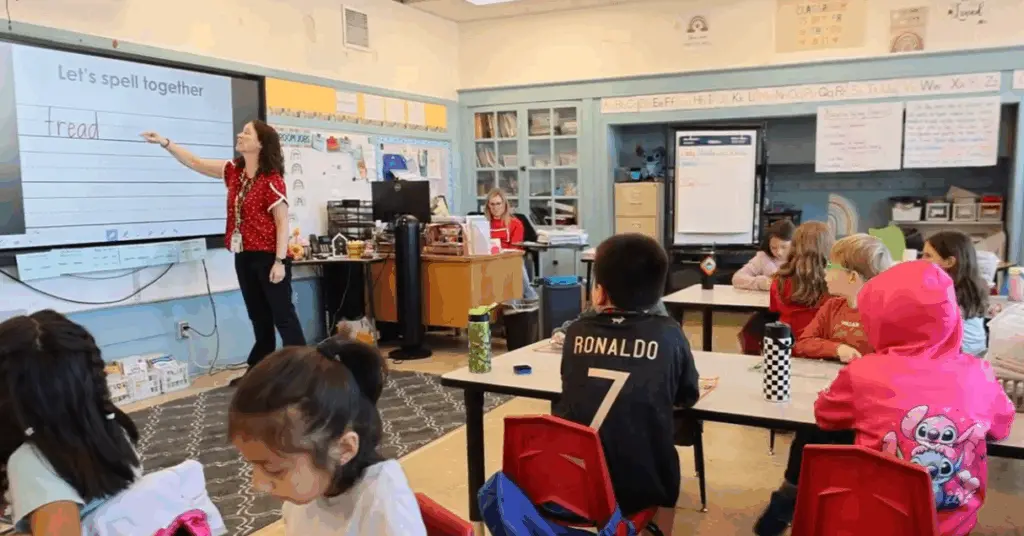
Klamath Falls City Schools is continuing to see positive momentum from a literacy curriculum now in its second year of implementation for kindergarten through second grade students.
The curriculum, known as UFLI Foundations, short for the University of Florida Literacy Institute, focuses on building early reading skills through explicit, systematic instruction in phonemic awareness. Across KFCS, UFLI is used daily in K–2 classrooms to strengthen students’ understanding of letters, sounds, and spelling patterns that form the foundation of reading and writing.
At Mills Elementary School, instructional literacy coach Lisa Najar recently dropped in on classrooms to observe UFLI instruction, including lessons led by second grade teacher Haley Butler and kindergarten teacher Kayla Pershall. Najar said the consistency of the program plays a major role in student engagement and success.
“Phonemic awareness is where reading starts,” Najar said. “UFLI focuses on letters and sounds, letter combinations, and the sounds they make. It’s very systematic and routine, so students know exactly what to expect, and each lesson builds on the one before it.”
UFLI lessons are taught for 30 minutes every day and follow an eight-step structure over two days. Students begin with auditory and visual drills, are introduced to new sound-spelling patterns, and then apply those skills through spelling, sentence writing, and reading connected text. While kindergarten students focus on basic letter sounds, first graders build toward more complex patterns and second graders tackle advanced phonics concepts.
“I would have my class go to another classroom and teach UFLI because they are phenomenal,” Butler said.
Mills Elementary Principal Chelsea Woods said year two of implementation has brought greater confidence and fluency among staff.
“There’s a lot more comfortability with the teachers this year,” Woods said. “They’re not having to relearn the program. It’s really about fine-tuning skills, and it’s running smoothly and efficiently. Our school is thriving in terms of the instruction that’s happening with UFLI.”
In addition to classroom instruction, educational support professionals (ESPs) also use UFLI in small-group settings to provide extra support for students who need additional practice. According to Najar, this expanded use allows students to receive multiple exposures to the same skills, strengthening learning outcomes.
While UFLI does not directly factor into traditional grades, Najar said the curriculum plays a key role in improving students’ reading and writing abilities, which ultimately supports stronger academic performance across subjects.
“Students aren’t graded directly on UFLI instruction, but they are assessed through formative assessments. That allows teachers to see where students are and identify if they need additional support with a particular skill,” Najar said. “When students apply those skills in reading and writing, that’s where we see the academic benefit.”
Learning at home
UFLI is an open educational resource, meaning much of the material is available online at no cost. Najar noted that families can access resources at home to better understand the skills their children are learning, reinforcing the connection between school and home.
“It was written by teachers for teachers,” Najar said. “Parents could even try to replicate parts of it at home if they wanted to.”
Districtwide, UFLI was adopted through a community input and school board approval process and is paired with an additional literacy curriculum that focuses on comprehension and vocabulary. Together, these tools are designed to ensure students develop both the foundational skills and deeper understanding needed to become confident readers.
“When the program is implemented well,” Woods said, “we’re seeing more growth than we normally would and ultimately, that leads to students being academically successful.”